Practice is at the heart of a musician’s life. While it is always beneficial to improve your practice habits, it is even more crucial after a playing-related injury. The possibility of pain and further physical damage often forces musicians to take a serious look at the quality of their practice sessions.
How much to practice after an injury depends on the individual situation, as different body conditions require different amounts of rest. But in any case, rest on its own rarely solves the problem. Practicing will eventually need to be reintegrated as part of the long-term recovery plan.
The goal should be to make your practice a health-promoting activity rather than a damaging one. The details of playing technique are a major component, which I’ve addressed in another article. Here I’ll be talking about additional strategies and conditions that will help make practicing part of the solution.
Choose repertoire wisely
There are two main points to makes about this.
First, whatever you were playing in the months leading up to the injury, change it up. Any music we’ve been practicing for a long time will have habits already built into it, whereas working on new repertoire provides a clean slate on which new, better habits can be written. The piece or pieces most associated with the pain should be taken out of the rotation for months, if not years. It should be possible to go back to the those pieces eventually if you make the right technique adjustments, but do it later rather than sooner.
Second, choose music that is conducive to healthy technique. Virtually anything can be played with healthy technique, however if you’re in a transition phase and trying to integrate new patterns, it is best to stack the odds in your favour.
In the piano world, we use the term “pianistic” to describe composers for whom the physical dimension of piano playing is integral to their musical language. I often recommend Clementi, Haydn, Burgmuller, Chopin and Rachmaninoff to students trying to reform their technique, as their music presents technical challenges compatible with natural movement patterns.
Warm up
High-level musicians should take a cue from athletes. What we do with our bodies can be just as demanding. A sprinter or football player would never go straight to full intensity without warming up their body first. Doing so would be asking to get injured.
A good warm-up for a musician includes both the release of tension and gradual activation of the musculature.
I have used relaxation practices from yoga and Alexander Technique, but there are many ways to release tension before a practice session. It could be as simple as sitting upright and taking a few slow, deep breathes while relaxing the shoulders and arms.
The next step is to get energy circulating from the back and shoulders out through the arms. I like to stand and hold my arms overhead for 10-20 seconds, then release them completely and wait 10 seconds before repeating.
When you do start playing, it is best to progress from slow to fast with an awareness of energy circulating from the centre of the body outward. If you’re going to use technique exercises, start with one that emphasizes larger arm movements (like octaves or chords on piano) before activating the fingers individually.
Take short breaks often
An arts-medicine physiotherapist I worked with in Toronto recommended stretching for five minutes out of every hour of practice, and I think that’s great advice. On my better days I follow it.
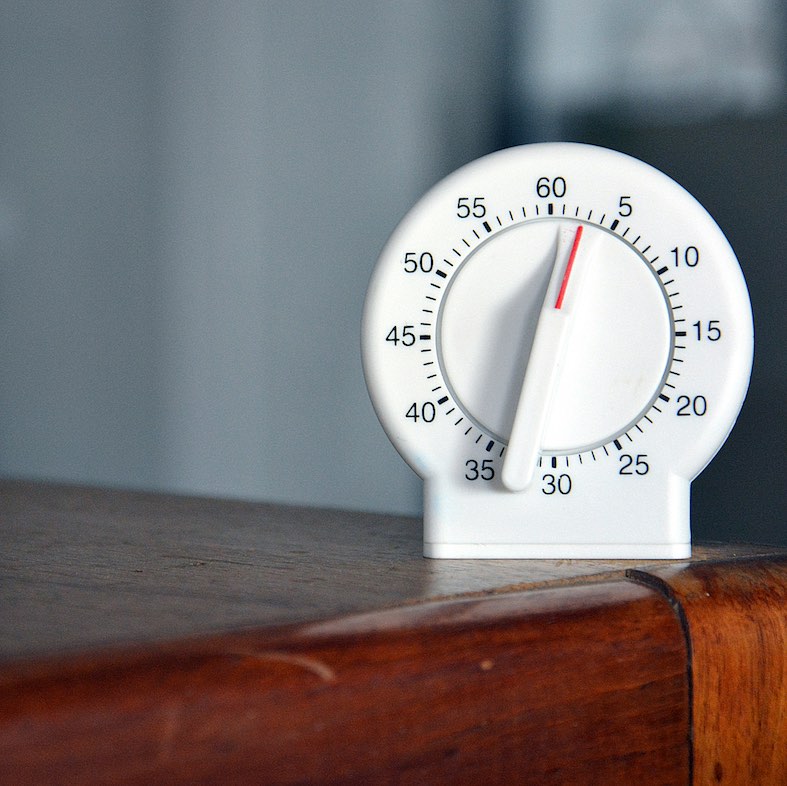
It can be helpful to set a timer for when it’s time to stretch so that you can concentrate for the length of a practice segment without looking at the time (especially if the time is on your phone!).
Even if you’re doing the right things technically, the forward-focused playing position can lead to accumulation of tension in the body. This can be counteracted by movements like back extension, quadriceps stretch, or pectoral stretch against a corner wall or door frame. In my experience, stretching larger muscles is more effective than focused stretching of the forearms and hands.
Quality over quantity
There is something to be said for blocking off long stretches of time to practice, but how you use that time is infinitely more important. Practicing should be a process of refinement and improvement, not repetition of familiar patterns over and over.
If you have pain related to playing, familiar patterns are likely part of the problem, so they need to be evaluated from a new perspective and in some cases replaced. There should be new information coming in about the physical aspects of playing, ideally one-on-one guidance from an expert on your instrument who can watch you attempt things and give feedback. If that is not possible, instrument-specific body mapping books can be excellent resources.
Wherever the new information is coming from, it will require conscious, deliberate practice to integrate it into your playing for the long term. Conscious practicing includes frequent silences in which you centre yourself, evaluate how something went and imagine a better way of doing it.
Some good questions to ask yourself would be:
- Am I trying too hard or using too much force?
- Could I stay rooted in my body’s structure and move less for a better result?
- Is my lower body free enough to provide dynamic support to the shoulders and arms?
- Is there a better fingering for this passage that could improve the flow of arm movement?
- Is my breathing free or restricted?
In effect, we need to be our own teacher. I forget this sometimes, like anyone else, but the important thing is to keep remembering and coming back to it.
Rebuild Confidence
Getting injured is a destabilizing experience for a musician. All this questioning of habits can understandably lead to fear and hyper vigilance around our practicing and playing.
After I got injured, I was lucky enough to work with one of the best piano teachers out there for holistic technique. In one of our first sessions, he gestured toward the piano and said, “It looks like you’re afraid of this thing.”
At that time, I didn’t fully understand what I had been doing wrong, and was afraid that anything I did at the piano could be hurting me. Fear is associated with contraction and tightening in the body, which is obviously not what we want during practice.
As soon as my teacher pointed that out, I understood that shifting my mindset would be essential. While working to ingrain the right technique patterns, he also helped me to feel more confident, and my confidence grew as I realized playing piano was making my arms felt better. I got to the point where good technique and confidence were fuelling one another in an upward spiral.
When the time was right, my teacher had me play the Khachaturian piano concerto, a fiery, bombastic piece that was well outside my usual stylistic wheelhouse. The kind of physicality and decisive energy required to play the Khachaturian turned out, unexpectedly, to be exactly what I needed to make a final leap onto the other side of the injury.
The mind and body are not as separate as modern culture would have us believe. When the mind-body system is acknowledged as a whole, like it is in many forms of practice from yoga to martial arts to tennis, greater possibilities for learning and change are unlocked.
Practicing well is one of the most important skills a musician can learn. It is too bad so many of us are forced to learn it through pain, but that often the way. Fortunately, after taking the bitter medicine, we have the skill for life.
I work with pianists online in 1-on-1 lessons. For more information about my teaching, click here.
 Patrick Cashin